|
|
News & Reviews Article
| Title |
Plants That Perform Well Under Low Light |
| Author |
Chris Deer
|
| Last Updated |
2014-12-13
|
| Abstract |
|
|
|
PLANTS THAT PERFORM WELL UNDER LOW LIGHT
by Chris Deer |
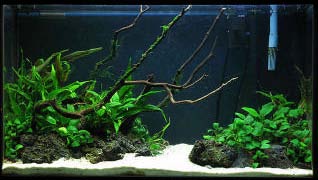 |
| You do not have to have intense lighting or fancy filtration to keep live plants as long as you understand your limits with the varieties of live plants you can house successfully. There are quite a few beautiful live plants that will thrive under standard wattage fluorescent fixtures using a lamp designed for growing live plants. This, along with a weekly fertilizer additive designed for aquatic plants, will allow you to maintain live plants without much fuss or extra cost. |
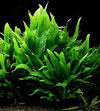 |
Java Fern has the appearance of a common Amazon sword plant. This plant prefers low light conditions and should never be planted into the substrate. Instead, the rhizome should be attached to driftwood and/or decorative rock using fishing line or loosely fitting rubber bands until the fine hair-like roots attach the plant. This plant can cover an entire rock quickly once established. Reaching about 8� in height, small baby plants grow from the tips of the leaves which are easily removed and |
| Java Fern |
| attached elsewhere to propagate this plant. You can also cut a section of the rhizome that contains leaves and attach it to another area of the tank. Most fish refuse to eat Java Fern as it supposedly has a bitter taste. Java Fern can be grown in soft water, hard water and even brackish water conditions. |
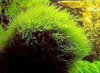
Java Moss makes a thick carpet on anything you or it attaches to. Take small pieces and attach it to rocks using fishing line and once established, it will cover the rock. The rocks can be lifted from the aquarium and trimmed to the desired height and form allowing you to create an interesting feature along the bottom of your
aquarium. Java Moss is extremely hardy (some say too |
 |
| Java Moss |
| hardy) and will need to be trimmed regularly to prevent it from covering everything in the aquarium! It can be attached to roots, driftwood, ornaments � well anything. This is the perfect plant to use in aquariums where you may want to protect fry fish. When attached to floating pieces of cork, it makes an outstanding media for fish like gouramis and bettas to build bubble nests within. Java Moss will survive in soft water, hard water and mildly brackish water. |
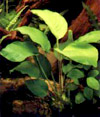 |
When writing this newsletter, I (Chris) always learn something new myself. In this case, I have been misspelling the word Anubias as Anubius for 20+ years! Anyway, AnubiAs plants have the appearance of an underwater philodendron. Depending on the variety, the leaves can be rounded, long and narrow and even forked. There are small varieties for using as a foreground (Anubias barteri var.nana) and larger forms for using as background plants (Anubias hastifolia). Nearly all of the Anubias plants available are extremely |
| Anubias species |
| hardy if cared for properly. These plants grow from the stolon (thick stem from where the leaves sprout) that should never be buried in the substrate. Instead, only the roots should be covered. Anubias will thrive on driftwood and rockwork as well. Because these plants tend to extremely slow growing, low light conditions are best. Under bright light, the plant will thrive but algae will begin growing on the leaves taking away the beauty of this majestic family of aquatic plants. Under low light, algae may still grow but can easily be removed by fish like Otocinclus, Siamensis Flying Foxes, Japonica Shrimp and/or Rubber Plecostomus. Avoid common Hypostomus plecostomus as they will damage the leaves enough to warrant removal. This is one of the few aquarium plants that flowers under water with a peace lily-like flower. These plants are considered one of the hardiest of all aquarium plants surviving in a pH of 5.5 to 8.0! Though Anubias are more expensive, you will likely never have to replace it. |
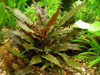
| There are numerous Cryptocoryne varieties available to the hobby but Crypt. wendtii is by far the hardiest one of all. This plant will thrive in both low and extreme lighting conditions. Crypt. wendtii should be planted directly into the gravel (fine grave l is preferred). If left alone, it will eventually begin sending runners under the substrate forming large clumps throughout the aquarium. Crypts do not like to be moved. When you |
 |
| Cryptocoryne wendtii |
first obtain your plant, it may shed most of its leaves in the first couple of weeks but do not discard the plant, it will quickly recover sending out masses of new foliage. Crypt. wendtii has been hybridized over the years with red, brown, green and even bronze foliage varieties now available on a regular basis. We sell this plant either by the stem or in clumps. The clumped plants suffer less root damage and tend to suffer less when moved. The only issue Crypts suffer from is temperature shock. Always acclimate this plant slowly and avoid moving it quickly into another tank. This is the perfect plant to use in the middle areas of your aquarium. Due to the soft foliage, avoid this plant in aquariums containing fish that eat live plants (silver dollars, severums, uarus, etc).
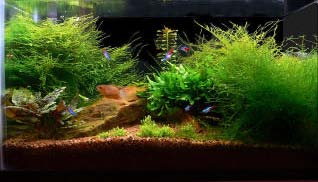
Now you have the perfect combination of plants to use in a low- light aquarium setting. Place your lights on a timer so the plant s will be given a regular light cycle of 8-10 hours per day. Add a liquid plant fertilizer (Kent Plant Supplement, Seachem Flourish, etc) weekly and do your regular 25% monthly partial water changes. Remember that fluorescent lamps should be replaced at least once every 10 months for optimum growth. Keep your glass tops clean so that the beneficial spectrum of light can reach your plants. Clouded glass tops will kill your live plants! When vacuuming the gravel, do not come too close to the root structure of your live plants. Vacuum about 2� away from the base of plants rooted in the substrate.
|
|
|

|
|
|
|